Random data source
GCP-style work begins with random number streams. The value is not in any single flash, but in comparing long-running random data against clearly marked events.
NCPCS Global Consciousness Project
An overview of the Global Consciousness Project idea, the NCPCS Global Consciousness Monitor, and a real-time coalescence engine for observing random streams alongside local, worldwide, and intentional events.
A random number generator, or RNG, is like an electronic coin flipper. If it is working normally, its output should stay balanced over time. GCP-style research watches many random outputs and asks whether they become less random during important moments.
The central question is whether moments of focused human attention, shared experience, group prayer, meditation, or significant world events can coincide with measurable departures from expected randomness.
GCP-style work begins with random number streams. The value is not in any single flash, but in comparing long-running random data against clearly marked events.
Meaningful review depends on timestamps. The engine stores samples, peaks, coalescence events, and markers so before, during, and after windows can be compared.
Local ZIP/area settings, worldwide activity, group prayer, meditation, and other intentional events can be marked to compare location and context against signal movement.
The original Princeton-era archive now points forward to GCP 2.0, which is maintained by the HeartMath Institute. The window below provides a live reference point when the external site allows embedding.
If the live window is blocked by browser security, use the buttons above. Some organizations prevent their sites from being embedded inside other pages.
The NCPCS engine is the working tool for this project. It observes configurable random streams, shows coalescing events with color coding, tracks repeated cells, and exports session data for further review.
Multiple RNGs, selectable colors, 9x9 grid coalescence, rolling anomaly scores, forward watch levels, ZIP/area profiles, marked events, group size, intensity, location weighting, top coalescing cells, and exportable JSON/CSV records.
This project is best approached as disciplined observation: collect data, mark events clearly, preserve records, and review patterns over time.
Repeated coalescence on the same cells, clusters of high-strength coalescence, rising watch levels near marked events, and consistent patterns across multiple saved sessions.
Random systems naturally produce streaks. Correlation is not causation. Stronger claims require documented event windows, saved exports, repeatability, and honest review of both hits and misses.
The project connects older GCP research, NCPCS hardware/software exploration, and newer AI-assisted review methods.
The Dartmouth workshop helped establish artificial intelligence as a research field. Modern AI now helps organize context, summarize events, and support review workflows.
The original Global Consciousness Project began continuous collection of random data from a distributed network of physical random event generators.
The original network commonly operated with dozens of reporting nodes and accumulated formal event analyses over many years.
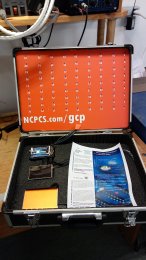
NCPCS developed earlier Global Consciousness Monitor concepts, including the archived brochure, Android application, and 9x9 visual-monitor approach. This earlier work helped shape the current NCPCS engine.
The Transformer architecture introduced a foundation for modern AI systems useful for classification, summarization, and signal review.
Roger Nelson asked HeartMath Institute to become the home base for the next phase, now presented as Global Consciousness Project 2.0.
Generative AI entered broad public use, making AI-assisted dashboards, research support, and event classification practical for smaller teams.
Roger Nelson published a review of historical GCP results and explanatory models in the Journal of Anomalous Experience and Cognition.
The original GCP archive reports that GCP 1 active data collection ended on April 3, 2026. Current forward work points toward GCP 2.0 and independent tools such as the NCPCS engine.
The NCPCS Real-Time GCP Engine extends the earlier monitor idea into a browser-based dashboard with multiple RNG streams, color-coded coalescence, location profiles, event marking, and exportable review data.
Local project files and external references for deeper review.
APK note: modern Android versions restrict sideloaded applications. Install only when the file source is trusted and device settings permit it.
References used for the public overview and timeline.